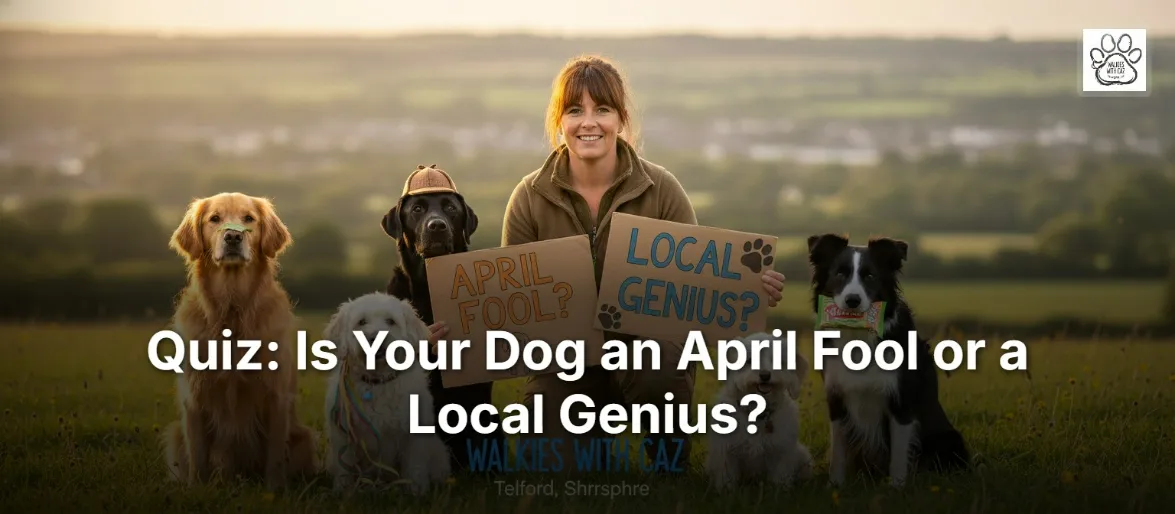
Every pet parent in Telford has been there. You come home to find a shoe has been relocated or a bin has been explored with forensic detail. While it feels like your furry friend is just being an April Fool, there might be a more impressive explanation. These moments of mischief often point toward high cognitive function rather than just a desire to be naughty. In the world of canine behaviour, the line between a prankster and a prodigy is remarkably thin.
At Walkies with Caz, we spend our days navigating the diverse personalities of pups across Priorslee and Shropshire. We see firsthand how a clever sausage dog can manipulate a routine to get an extra treat. Understanding whether your dog is acting out or solving a puzzle is the first step to better care. This assessment helps you distinguish between accidental chaos and calculated problem-solving. By the end of this article, you will know if you have a local genius on your hands.
Professional pet care services
The Science Behind Canine Intelligence
Canine intelligence is not a single trait. Experts generally divide it into three distinct categories: instinctive, adaptive, and working intelligence. Instinctive intelligence relates to what the dog was bred to do, such as herding or retrieving. Adaptive intelligence is the ability to learn from the environment and solve new problems independently. Working intelligence is the capacity to learn from humans and follow specific commands. A dog who ignores a 'sit' command might lack working intelligence but could rank highly in adaptive intelligence if they can find a hidden treat in seconds.
The average dog can learn approximately 165 words, signs, and signals, which is similar to the mental capacity of a two-year-old human.
SourceWhen we provide pet care in Shropshire, we often observe these traits in action. A dog who waits for the exact moment you look away to snatch a biscuit is showing theory of mind. In practice, they understand what you can and cannot see. It is a sophisticated mental process that goes beyond simple obedience. Instead of seeing a 'naughty' dog, we see a creature with high spatial awareness and timing. Recognising these traits helps us provide tailored care that keeps their minds active and their tails wagging.
The Dog Intelligence Assessment
Answer these questions to see if your dog's cheeky behaviour is actually a sign of high IQ.
0 of 5 answered
Question 1 of 5
How does your dog react when you pick up your car keys or put on your walking boots?
Interpreting Your Results
If your score indicates a high-intelligence dog, do not be surprised if they require more engagement than the average pet. Smart dogs often display selective hearing. This is not because they do not understand you, but because they have weighed up the options and decided that the squirrel in the tree is more interesting than your command. This is why we offer tailored 30 and 50-minute dog walking options. These sessions allow us to provide the specific level of mental and physical exertion your dog needs.
For the 'April Fools' who scored lower, life is often simpler and less stressful. These dogs are wonderful companions who rely heavily on their pet parents for guidance. They might not be able to unlock the back door, but they are often more focused on social bonding and affection. No matter where your dog sits on the scale, their unique personality is what makes them a vital part of your family. Our goal is to support that bond by providing professional care that respects their individual temperament.
Caroline's Take 🐾
From my experience walking dogs across Telford, the 'smartest' breeds aren't always the easiest. A genius dog without a job will often invent their own, usually involving your furniture. Providing mental enrichment through varied smells and social interaction is just as important as the physical walk itself.
Keeping Your Genius Busy
Managing a clever dog requires a bit of strategy. First, change your walking routes frequently. Exploring a new part of Priorslee or a different trail in Shropshire provides fresh scents that act like a crossword puzzle for a dog's brain. Second, use your dog's mealtime as a training opportunity. Instead of a bowl, use a puzzle feeder that requires them to nudge or slide compartments to find their food. This burns mental energy and prevents boredom-related destruction.
If you are at work all day, consider our pop-ins or doggy day care services. A short visit can break up the day for a high-energy dog, providing the social interaction they crave. We are DBS checked and dog first aid trained, so you have complete peace of mind while you are away. We understand that every pet is different, from the smallest sausage dog to the largest retriever. Our care is always adapted to their specific cognitive and physical needs.
Can a dog's intelligence change over time?
While a dog's base cognitive potential is largely genetic, their problem-solving skills can be improved through training and enrichment. Regular mental exercise keeps their brain sharp as they age.
Is a naughty dog always a smart dog?
Not necessarily. Naughtiness can stem from lack of training or anxiety. However, if the dog is using creative ways to get what they want, it is usually a sign of high adaptive intelligence.
Which breeds are typically the smartest?
Border Collies, Poodles, and German Shepherds often top the lists for working intelligence. However, individual personality and environment play a massive role regardless of the breed.
How do I stop my smart dog from getting bored?
Use a mix of physical exercise, scent games, and new tricks. Rotating their toys every few days also helps keep their environment feeling fresh and interesting.
🐕 Does Your Local Genius Need a Walk?
Whether your furry friend is a brilliant problem-solver or a happy-go-lucky prankster, we provide the professional care they deserve in Telford and surrounding areas.
Book a Consultation Today